



THE INTERVIEW
Ashkan Nejad Ebrahimi
1. Could you share a bit about your background and what led you to start your art practice?
I’m from Iran, so I started my practice there. I studied fine art for my bachelor's degree, and at that point I actually wanted to become a filmmaker. Everything I was doing—making short films, editing for other filmmakers, and working on movie sets—was directed towards that goal. But despite my efforts to steer my career towards film, things weren’t progressing much.
At the same time, because I was studying fine art, I started submitting the projects I was doing for my degree to exhibitions. I hadn’t expected it, but I started receiving some positive feedback on my art.
I remember doing an installation for a group show at a gallery, and a few months later, the gallery contacted me and said that they’d like to pay me to create a large scale version of it. That was a turning point. Even though I was still trying to be a filmmaker, I found myself making installations and sculptures, and gradually realized maybe this was the path for me.
After finishing my bachelor’s degree, I applied to a few universities outside Iran because I wanted to pursue an interdisciplinary practice, which is a bit difficult to do in Iran. Most master's programs focus on one medium or one type of practice. I found that Canada had many art schools offering interdisciplinary programs, and the School of Art became my final choice. So, I moved here, did my master's degree, and that’s how I ended up pursuing this career in Canada.
2. What themes does your work explore?
My work generally explores the intersections between imagination and reality in different contexts. Over the past few years, I’ve focused on topics like the intersection between science and fantasy, memory and nostalgia, and the relationship between copies, replicas, and originals.
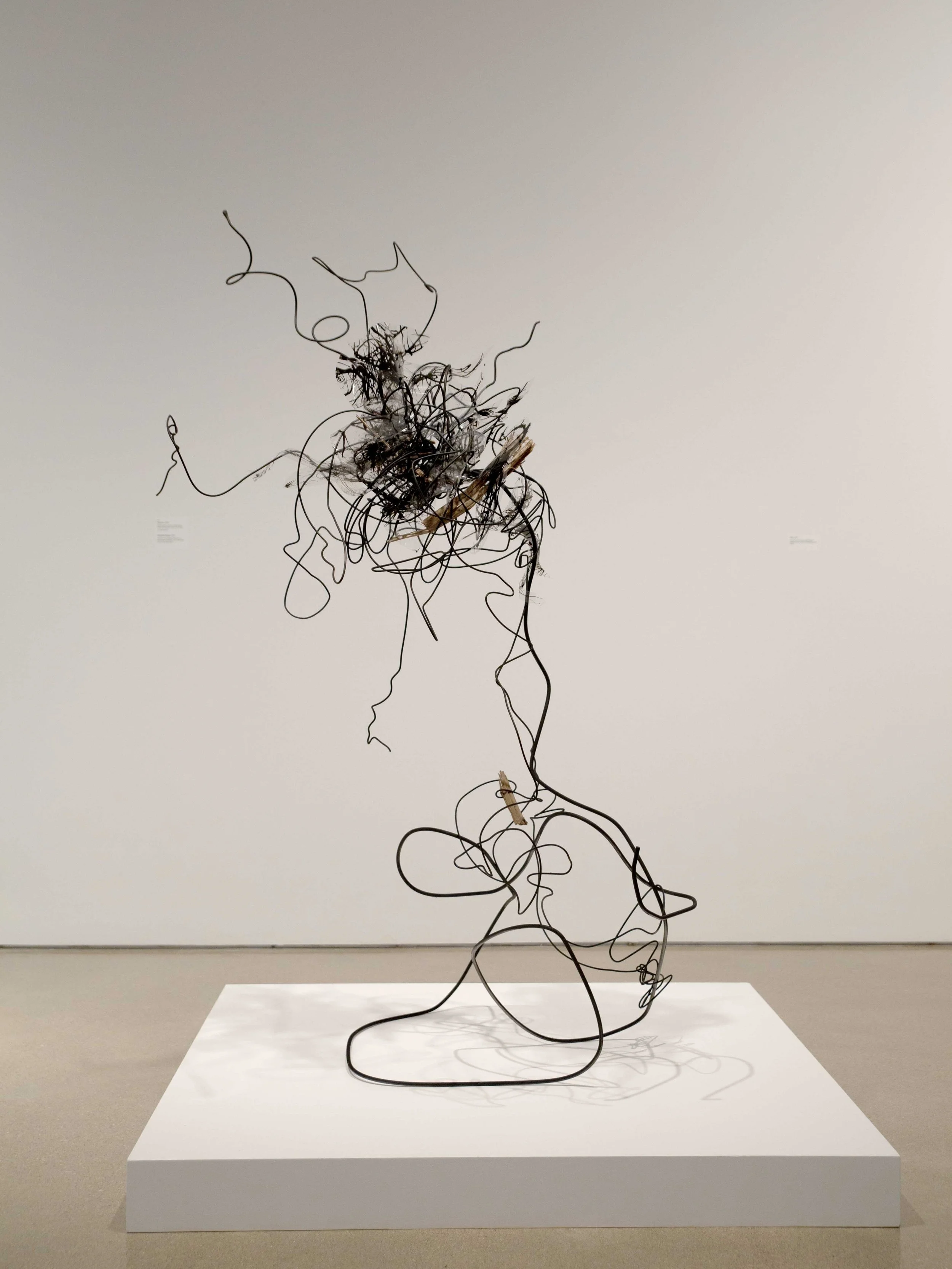
But if I were to be more specific about my practice, especially since moving to Canada, I’d say it’s mostly about mark-making and drawing.
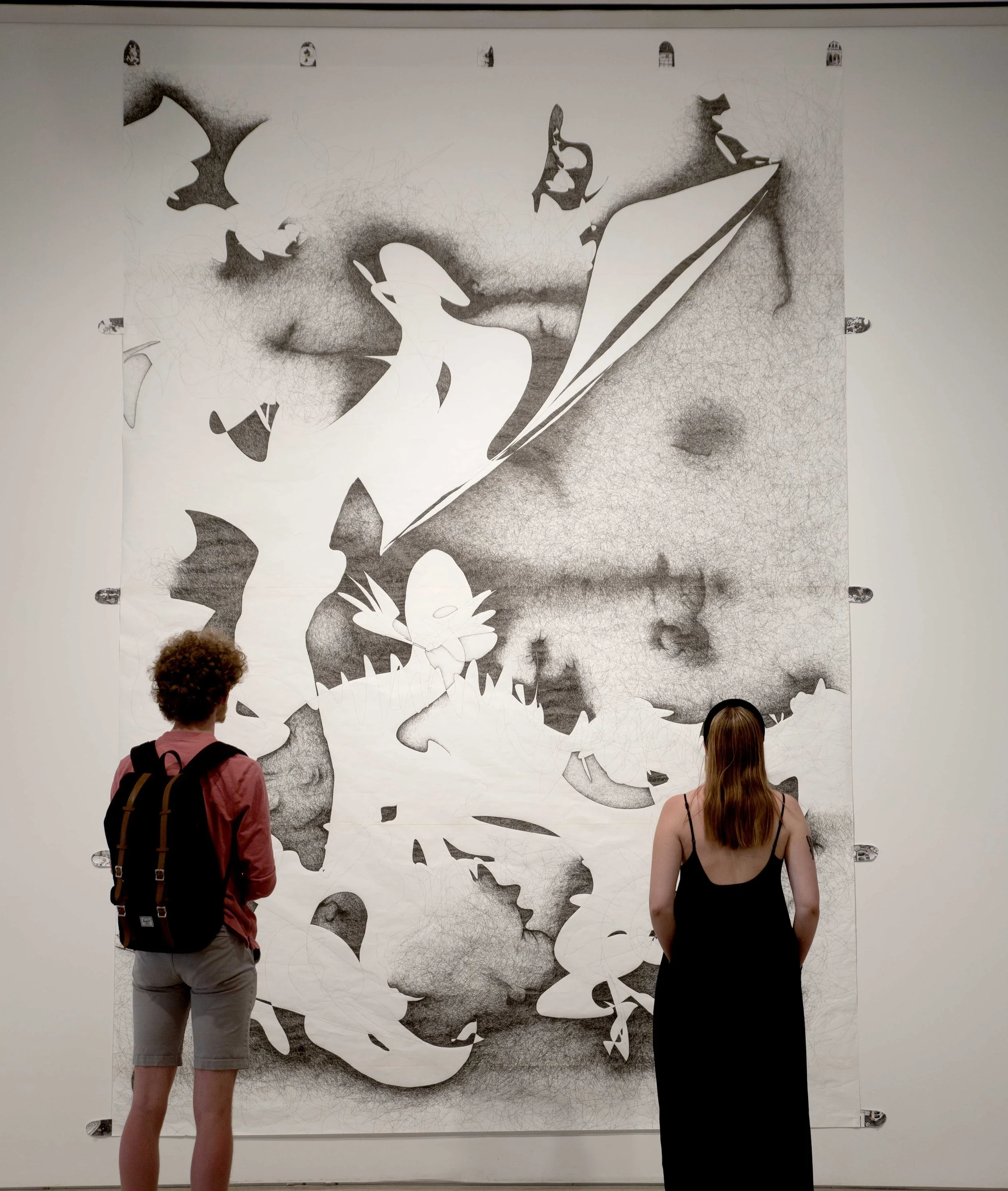
My practice is very focused on the process of mark-making. Sometimes it takes the shape of a sculpture, a three-dimensional piece. Other times, it’s simply a drawing hanging on the wall, or even drawn directly on the wall instead of paper. The core of this mark-making process is about the connection between the mind and the body—how thoughts travel from the mind, through the nerves, and into the hand, eventually reaching the paper.
So, my work is deeply about this interaction between mark-making and the body.
Even when I install works in galleries, I think a lot about how my drawings will relate to the viewer’s body. The physical connection is really important for me.
Q: Would you say your work is about unconscious memories that exist in both the mind and the body?
Yes, absolutely. One of the subjects I researched during my master's degree was the unconscious, particularly the surrealist approach to automatism. As you may know, the idea of working with the unconscious mind was widely used in Surrealistic Automatism in Europe and moved to the U.S. and helped shape abstract expressionism. This is something that has influenced me greatly, particularly through artists like Jackson Pollock, and it’s a big part of how I approach my own work.
There’s also a material limitation in my practice, since I mostly work with pen, ink and watercolour. I have to lay large sheets of paper on the floor and work horizontally, rather than putting the paper on a wall or drawing board. It’s an interesting way of working that directly connects to my exploration of the unconscious and free-flowing expression.
In addition, the idea of working with paper and light pigments such as inks has come from Iran’s history of art where the largest portion of paintings and drawings were created on paper instead of canvas, fabric or walls, as the main purpose of those artworks was to serve as illustration in books (poems and literature). I like to think about this as my historical unconscious that has stayed with me through visual culture.
3. How has your work evolved over the years, and what has influenced those changes?
That’s an interesting question. There are usually two types of artists I think about when it comes to style:
One type has a very specific, recognizable style. You encounter their work, and immediately you know it's theirs, whether it’s a film, fine art, or music.
The other type of artist explores different styles and possibilities in their work, continuously changing.
I’d say I experience both. If I look back at my career, from when I started in Iran about ten years ago, through all the series I’ve created, I see some repeating elements, but the style has always varied slightly. The repetition lies in the elements, but the style itself shifts. This is especially true because I enjoy experimenting with different mediums.
After moving to Canada, my work started to solidify around the idea of mark-making. That brought a bit more specificity to my style. So now, when I look at my work from the past few years, it has definitely changed, but it’s much more cohesive in terms of style.
One other thing that comes to mind is the subjects I focus on. I’m just a curious person, so I explore different things that shape our world. I read books, watch documentaries, and just search for elements that influence us. At some point, something in science, philosophy, or psychology will catch my interest, and it will inevitably find its way into my work.
So, there’s always something new inspiring me at any given moment.
4. What is the biggest source of inspiration for your work?
There’s an important filmmaker in Iran named Abbas Kiarostami. He passed away a few years ago, but I remember him once speaking about how he chose his sources of inspiration. It stuck with me, and now it’s how I think too.
For me, the source of inspiration is life itself—not books, not movies, though they are part of life. Life, as a whole, is the real inspiration. I believe part of an artist's work begins the moment they leave their studio or home and witness how the world works, how people interact, and how events unfold. All of that is an endless source of inspiration.
5. What is the most challenging stage of the creative process for you, and why?
Since moving to Canada, most of my work has been abstract. Working on abstract pieces gives me almost complete freedom. I can draw a line in any direction I choose. But that freedom can also lead to chaos. The biggest challenge is deciding which line to draw, and what that decision means to me.
I’m constantly critiquing myself, asking, ‘Why did I choose this? What is the reason for this choice?’ It’s a process of being as honest with myself as possible.
One thing I don’t do is listen to music while working, because it distracts me and creates false emotions. For me, the most critical part of working in the studio is being fully aware of my own feelings—whether I'm happy, angry, hopeful, or disappointed. I want to be conscious of how my emotions affect the work.
Q: When you enter the studio, do you have an emotion in mind, or do you let the work unfold on its own?
It’s a bit of both. Sometimes I have an image in my mind, not necessarily the final piece, but an idea—like trying a new tool or a new way of working. Right now, I’m experimenting with painter’s tape, and it started from the idea that it could add a new element to my work.
Other times, I just start working without knowing where the piece is going. That’s the most challenging way to work because it’s unpredictable and there’s a higher chance of failure. But it’s also interesting, because even if it doesn’t turn into the final piece, I often find something in the process that stays with me and influences future works.
Q: Would you say that’s when the unconscious comes into your practice, when you just want to see what happens?
Exactly, yes.
Sometimes I don’t have any clear plans or new ideas, but there’s this need to express something. That’s one of the core elements of mark-making—like doodling. It’s something people do without thinking, whether it’s in a textbook or a scrap of paper. It’s the mind’s way of finding expression, even if you're not consciously aware of it.
6. What is the project you're most proud of to date?
That’s a tough question. I don’t know if I have a definitive answer.
But I’d say one of the pieces I’m proud of is from a few years ago, part of my solo exhibition for my master's degree. It was a piece called Twirl, created on a ten-by-four-feet sheet of paper using only ballpoint pens. I wanted the piece to reflect a specific moment in my life, during the second year of my master's program.
It took two or three months to complete, and it was all narrow lines, with some areas completely dark from the layers of ink. Right now, I don’t think I have the endurance to make something like that again. It’s a very specific piece for me.
Q: Do you think it's a bit of an exercise in endurance to create a work like that?
Yes, definitely.
When you’re in an art school, especially during your master’s degree, you’re very isolated in your process. Unlike during your bachelor’s, when you have more time to experiment, a master's program is shorter, and you have to make more focused decisions.
During that period, it’s just you, the studio, and your materials. It’s a time when you can truly focus on a piece for months at a time. That kind of focus is rare outside of art school, where life’s pressures might take over.
7. Do you see yourself staying in Winnipeg long-term, or are there other cities that inspire you to work there?
That’s a question I don’t have an answer for right now. I like Winnipeg; it was my gateway to Canada. Right now, I feel comfortable here, and many of my friends in other parts of Canada are facing challenges—economic, social—that affect their ability to create art.
I’d say I’m mostly interested in staying here. Opportunities are important, but I tend not to base my decisions solely on them. For me, comfort and the ability to grow with the people around me matter more.
Here in Winnipeg, I have many friends, and I’ve enjoyed past collaborations with people here
For now, I want to stay here, but I don’t know what will happen in five years. I don’t like to make plans; I prefer to see what happens.
Q: Would you say that Winnipeg is like home to you now?
That's an interesting question. A few weeks ago, I was thinking about what home means. As an immigrant, I don’t know if Winnipeg, Iran, or somewhere else I might move to in the future is my home.
As an immigrant, it’s a tough question to answer. Sometimes I miss Iran and think of it as home. Other times, when I consider my career and my life here, I think, ‘Maybe Winnipeg is home now.’ I’m not sure. It really depends on the situation.
8. Do you think your practice would look different if you were based in another city?
Definitely.
When I moved to Winnipeg, I chose the University of Manitoba based on limited information from far away. I was fortunate that things went well here, and I was able to establish myself as an artist and get involved with the community.
Winnipeg has an active art scene with many galleries, which has been crucial. Some cities don’t have that, and that definitely impacts an artist’s career.
Another important factor has been the people I’ve worked with, both in the university and outside as collaborators. They’ve inspired me in different ways.
I’ve also been influenced by the Western contemporary art scene, particularly its emphasis on process-based work. Back in Iran, I would carefully plan my pieces—starting with sketches and then making the final work based on those. But in Canada, I learned to start directly on the piece itself, which aligns with my current approach. That’s been a big shift in my practice.
9. What would you like to accomplish in the next few years?
A few years ago, I would have said that my goal was to become a full-time artist. While that’s still a wonderful idea, it’s not my priority right now.
In the past few years, I’ve realized that having the freedom to work independently of the market is incredibly valuable. My daily job, as a video technician at the School of Art, is related to art, and I enjoy it, but it’s not about creating my own work. Right now, I’m happy with this balance, as it gives me the freedom to experiment in the studio without worrying about market pressures.
So in the next few years, I want to focus on establishing myself further, improving the quality of my work, and collaborating with more people.
I also want to increase the scale of my work. Right now, I’m limited by space in my studio, but I’ve worked on large-scale pieces before and want to expand on that. I also want to further explore the language I’ve developed in my practice, rather than branching into different mediums.
And yes, I hope to collaborate with galleries in other Canadian cities and work on getting grants. I have a solo exhibition at Forest City Gallery in Toronto next October. I also have a few group exhibitions lined up, but I need to confirm the dates.
10. If there’s one thing you hope people take away from your work, what would it be?
I love when people tell me that my work reminds them of a memory they hadn’t thought about in a long time or evokes a certain feeling. That’s what I aim for—to engage the audience’s imagination and senses.
I think it’s important that when the audience encounters my work, it’s just the artwork and the viewer, without the artist’s ego directing the experience. For me, success is when the work gives the audience the freedom to interpret and feel what they want, rather than pushing them to think or feel something specific.
Maybe that’s one of the reasons I work in abstraction—it allows for a more open-ended experience. I don’t want people to read the text on the wall before engaging with the work; I prefer them to have their own experience first.